5 of 7 Held: My 2026 Energy Predictions, 6 Months In
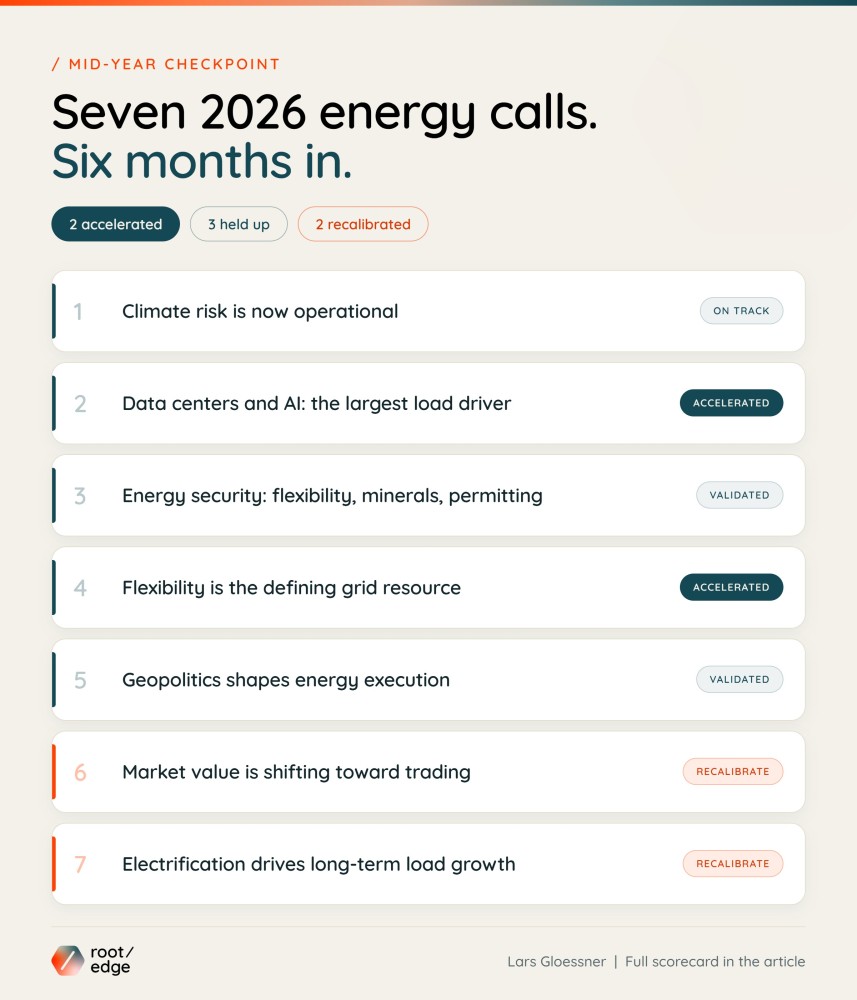
In January I published seven calls on where the energy market was heading in 2026. It is July. Here is the honest scorecard: five held, two of them faster than I called, and two I need to recalibrate.
I track my own predictions the way I track a search. If the thesis was off, I want to know why before I make the next call.
One finding sits above the rest. In January I framed data centers as one of seven parallel trends. Six months in, they are the master variable. AI load is the force amplifying grid resilience spend, storage deployment, the equipment shortage, the nuclear revival, and merchant trading economics. Almost every other call on this list traces back to it.
1. Climate risk is now operational. On track.
Resilience moved from strategy decks into capital plans. Federal grid strategy now names climate resilience as a core objective, and DOE's GRIP program keeps channeling investment into hardening transmission and distribution, with awards on the next tranche expected between October 2026 and January 2027. Utilities are replacing wood poles with steel and composite, running high-temperature low-sag conductors, and selectively undergrounding.
One nuance I missed. The spend is now justified as much by load growth and reliability under data-center demand as by climate adaptation. Same work, different budget line.
The talent I flagged (grid hardening, T&D planning, asset management, adaptation modeling) is still hiring.
2. Data centers and AI are the largest load-growth driver. Accelerated past my own call.
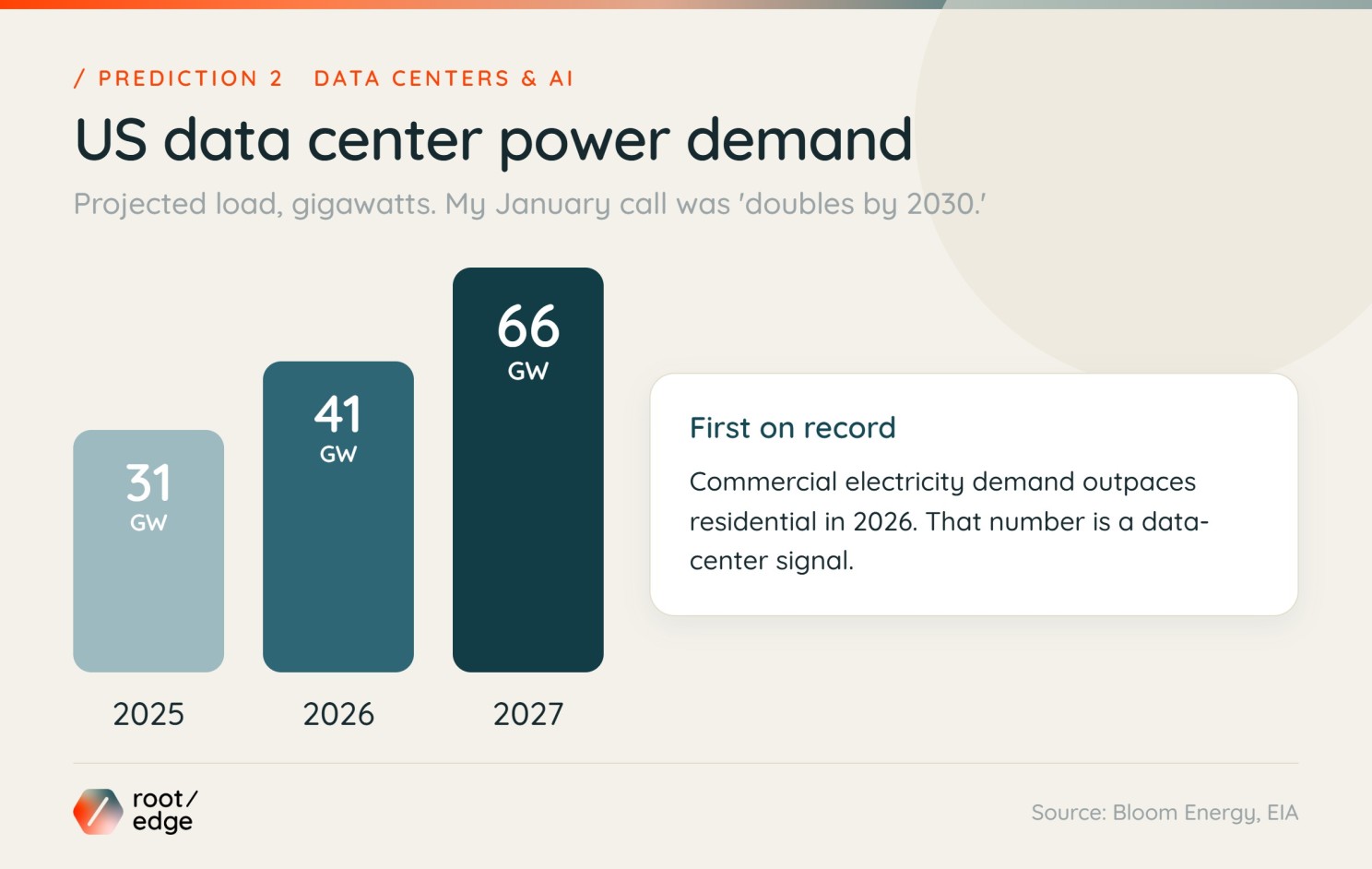
I said demand would double by 2030. That now reads conservative. US data center power demand is tracking from roughly 31 GW in 2025 to 41 GW in 2026 and 66 GW in 2027 (Bloom Energy). Data centers could add about 125 GW of US load through 2030, pushing overall demand growth to a 4.1% CAGR (BofA). For the first time on record, commercial-sector electricity demand is expected to outpace residential in 2026 (EIA). That number is a data-center signal.
The constraint flipped. The market is no longer short on demand or even capital. It is short on where power can actually be delivered. The US needs more than 230 GW of new capacity in five years and regulated utilities are on track to add about 93 GW. Over 7.5 GW of data-center projects with on-site generation are already under construction, with 60 GW more in pre-construction.
This is the root/edge wheelhouse, and it got hotter: HV and MV equipment, protection and controls, substation project management, grid-integration and load-forecasting roles.
3. Energy security depends on flexibility, minerals, and permitting. Validated.
All three held. Critical minerals became a formal diplomatic priority (the 2026 Critical Minerals Ministerial in February). The core problem is unchanged and stark: the average US mine takes about 29 years to permit, and China controls roughly 60% of global processing capacity. The consensus this year is the point I would add if I wrote it again. Permitting reform is necessary but not sufficient. Processing, capital, offtake, and skilled labor matter just as much as approvals.
The milestone I anticipated arrived early. Renewables overtook coal in global electricity generation for the full year 2025, confirmed by Ember's Global Electricity Review 2026, released in April. Roles in permitting and regulatory strategy, HV manufacturing leadership, and supply-chain are all live.
4. Flexibility is the defining grid resource. Accelerated.
Storage beat the trend line. Q1 2026 set a record with 9.7 GWh of new BESS installed, up 32% year over year (SEIA). The country now has about 44.6 GW operational. Virtual power plants are scaling on the same driver: Wood Mackenzie attributes a 33% jump in VPP deployments to data-center demand, concentrated in PJM and ERCOT, the two biggest data-center load markets. Storage is increasingly how utilities and data centers get online faster while interconnection drags.
BESS integration, EMS and SCADA, DER and VPP integration, optimization and real-time operations. Confirmed and scarce.
5. Geopolitics shapes execution. Validated, and it intensified faster than I signalled.
This is where I understated the pace. The US pivot was sharper than my January framing. The One Big Beautiful Bill Act curtailed the wind and solar PTC and ITC and is ending most consumer clean-energy and EV credits through 2026 (Arnold & Porter). Europe went the other way: CBAM entered its definitive phase on January 1, adding an estimated 5% to 8% cost premium to Chinese wind towers in Q1 (Bruegel), alongside steep tariffs on Chinese clean tech. The UK is pressing ahead on Clean Power 2030 through Great British Energy, a public-investment model that diverges from both.
Three major economies, three different rulebooks. That makes strategy, policy, government affairs, and cross-border commercial leadership more valuable now than it was in January, not less.
6. Market value is shifting toward energy trading. Directionally right, and I need to calibrate it.
The direction holds, but the pace varies by market and I painted it too broadly. In ERCOT, arbitrage is now about 26% of battery revenue and rising as ancillary-service prices decline and saturate. Revenue is brutally concentrated: ERCOT's ten best days delivered roughly 38% of annual battery revenue in 2024 (Modo Energy). That volatility is exactly why trading and forecasting skill separates the winners. But CAISO is still dominated by Resource Adequacy contracts, expected to stay that way beyond 2035. Trading-led monetization is real in merchant markets. It is not yet universal.
Portfolio optimization, storage-experienced traders, revenue strategy and hybrid-asset valuation. Real demand, concentrated where the markets reward it.
7. Electrification drives long-term load growth. Holds long-term, with a near-term headwind I did not weight enough.
The structural trend is intact. EIA projects record demand of 4,195 TWh in 2025, 4,271 in 2026, and 4,397 in 2027, after 15 flat years. The twist is on the consumer side. OBBBA ended the residential clean-energy and efficiency credits at the end of 2025 and winds down the EV and charger credits through mid-2026. So heat pumps, rooftop solar, and consumer EV adoption face a policy headwind even as aggregate demand climbs.
The demand story in 2026 is led by the commercial sector and large industrial load, not the consumer. The trend was right. The driver mix shifted under it.
What this adds up to
Five of the seven held. The two I would rewrite are trading (truer in ERCOT than everywhere) and electrification (right trend, wrong engine). What I underestimated was speed: the AI load curve and the US policy reversal both moved faster than the January piece implied.
And under all of it sits the same bottleneck. Power transformers now carry roughly 128-week lead times, with high-capacity units quoted four to five years out (pv magazine). You cannot order your way out of that, and you cannot capital your way out of it either. Every confirmed trend on this list resolves into the same question: who is going to engineer, build, and operate this.
The companies winning right now are not the ones chasing the demand headline. They are the ones who locked equipment and interconnection positions early and are building the technical teams now to execute when the permits clear. That last part is where root/edge works.
Which of these do you think I have wrong, and where are you seeing the crunch first: equipment, permits, or people?
Sources: Bloom Energy 2026 Data Center Power Report; Bank of America and Goldman Sachs via Utility Dive; EIA Short-Term Energy Outlook (July 2026); SEIA Q1 2026 Energy Storage Monitor; Wood Mackenzie via Utility Dive; Ember Global Electricity Review 2026; Arnold & Porter and Thomson Reuters on OBBBA; Bruegel on CBAM; Modo Energy on ERCOT/CAISO battery revenue; pv magazine USA on transformer lead times; DOE GRIP program.