Why Companies in Power Are Quietly Recruiting Canadian Engineers
750,000 new energy workers needed by 2030. 2.4 workers retiring for every one entering the field. 89% of employers hiring electrical engineers in power distribution and power systems can't find qualified people. A $100K fee on every new H-1B petition, and now uncertainty on OPT work authorization for the international students who make up a large share of the pipeline. The math doesn't work.
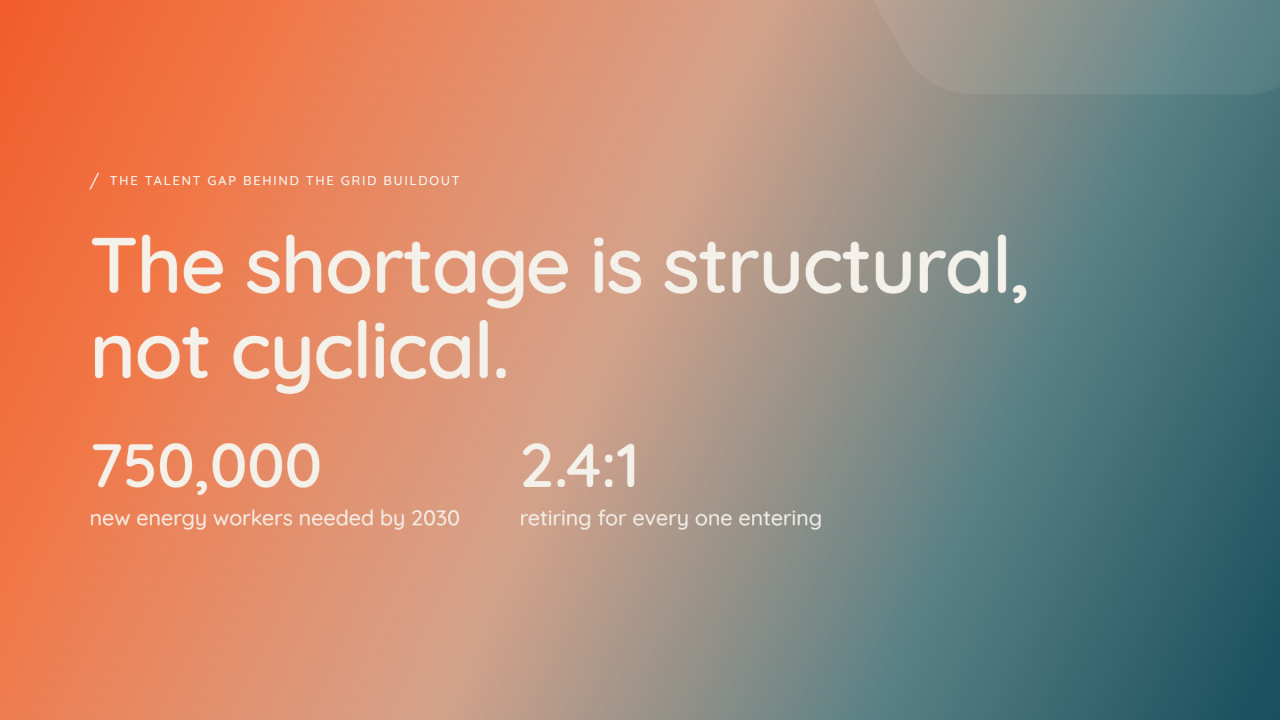
The Shortage Is Structural, Not Cyclical
I've spent the past few months running searches for power systems engineers, protection and controls engineers, and T&D leads, and the pattern doesn't change from search to search. The strongest candidates are sitting on three active offers before I've even finished my first round of calls. Clients end up competing against their own peers for the same dozen or so people in a given specialty. And timelines that used to run eight weeks from kickoff to offer are now stretching to five or six months, because there's simply nobody left on the bench.
This is an industry that spent three decades being stable, steady, and honestly a little forgettable. Utility jobs were the kind of career your parents were relieved you picked: predictable, unglamorous, nobody writing a LinkedIn post about it. Electrification and distributed generation started to change that shape a few years back, and then AI and data center load came in on top of it and pushed the whole industry into a category it's never really occupied before.
So this isn't a normal hiring cycle that will correct itself in a year or two once companies catch up on postings. It's structural, and every year it compounds on itself rather than easing.
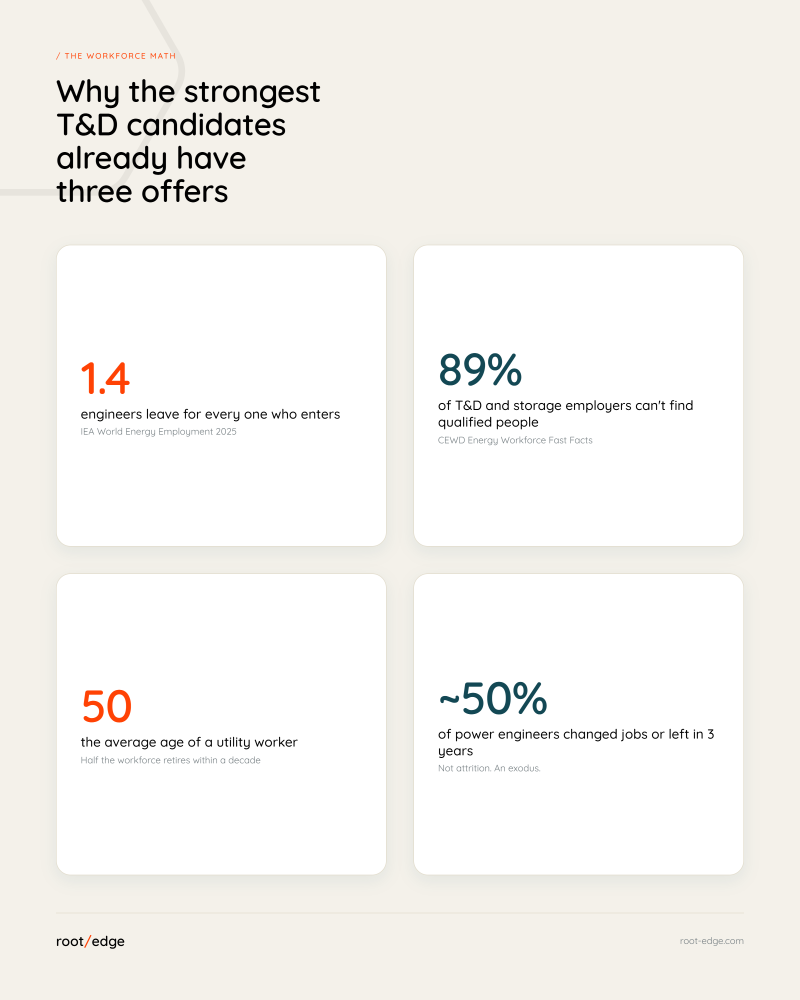
Part of the problem is that the talent pipeline was already thin before this growth even started. Fewer US students choose engineering every year, and within engineering, power specifically has been losing ground to software and data science, which students see as the more exciting, higher-paying path. Because of that, a large share of who's actually left in graduate power engineering programs is international: undergrads, master's students, and PhD candidates from Europe, the Middle East, and Asia who came to the US specifically to study power systems and controls. Layer the retirement math on top of that thin pipeline and the picture gets worse fast. The average utility worker is 50 years old. A quarter of the current workforce is projected to retire within five years, and half within a decade. For every young engineer entering a grid-related role, roughly 1.4 workers are heading out the door, according to the IEA's World Energy Employment report. Nearly half of power engineers changed jobs, changed employers, or left the industry altogether in just the past three years. That's not ordinary attrition. That's an exodus happening at the exact moment demand is accelerating in the other direction.
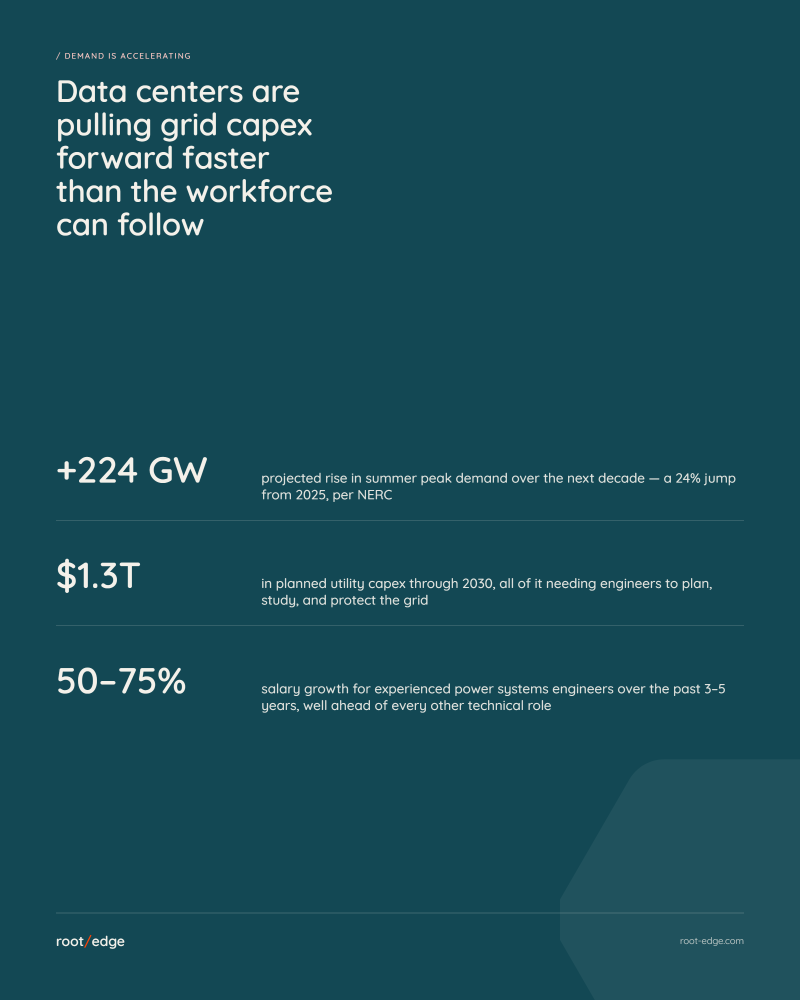
And demand really is accelerating. NERC's latest reliability assessment projects summer peak demand will climb 224 GW over the next decade, a 24% jump from 2025 levels and 69% higher than what NERC itself was projecting just one year earlier. Data centers are driving most of that increase. PJM's reserve margins are set to fall below reference levels starting in 2029, and MISO and ERCOT are working through versions of the same math on slightly different timelines. Utilities are responding with roughly $1.3 trillion in planned capital spending through 2030, and every dollar of that capital eventually needs an engineer behind it to plan interconnections, run power system studies, and design protection schemes. I've watched experienced engineer salaries climb 50 to 75% over the past three to five years, well ahead of every other technical role I track, which tells you this isn't a normal labor market. It's a market that's pricing in a shortage that hasn't even peaked yet.
The Immigration Wall
The visa system was supposed to be the release valve for exactly the population of international talent trained inside US engineering programs, and right now it's doing the opposite. New H-1B petitions filed after September 21, 2025 carry a $100,000 employer fee, which changes the math on sponsoring anyone below the most senior level. On top of that, starting with the March 2026 registration cycle, USCIS moved to a wage-weighted lottery: Level I entries get roughly 8.5% odds of selection, while Level IV entries get roughly 34%. That helps a client sponsoring a senior power systems engineer at the top of the pay scale, but it does very little for the mid-career T&D talent most clients actually need to hire in volume. Even a candidate who clears the lottery isn't in the clear. The green card backlog is still waiting on the other side, with EB-3 priority dates for India-born applicants sitting more than 12 years behind current filings, so a candidate can win the H-1B lottery and still spend the next decade in visa limbo.
And there's a newer wrinkle underneath all of that. A recent rule change moves F-1 students off open-ended "duration of status" and onto fixed admission periods, which means many students now need two separate USCIS approvals, an employment authorization document and a separate extension of stay, instead of just one. Employment generally can't start until both are approved, and DHS hasn't committed to any binding timeline for keeping the two in sync. For a hiring manager trying to plan a start date around a new engineering grad's OPT authorization, that's a real risk of a delayed start or an interruption mid-onboarding, on top of everything else already stacked against sponsorship.
The Canadian Option
Given all of that, more clients are starting to look north. Immigration for engineers into Canada is genuinely easier than into the US, and the interest reflects it. The TN visa has no annual cap, no lottery, and no $100,000 fee attached to it. Most approvals process in under 30 minutes at the border, for a filing fee of $50. Engineer, in any discipline, is on the list of qualifying occupations. Status runs for three years at a time and renews indefinitely, without the multi-year wait that comes with almost every other path into the US. For a Canadian P.Eng working in T&D or power systems, moving to a US employer costs a fraction of what the H-1B route costs and carries almost none of the risk.
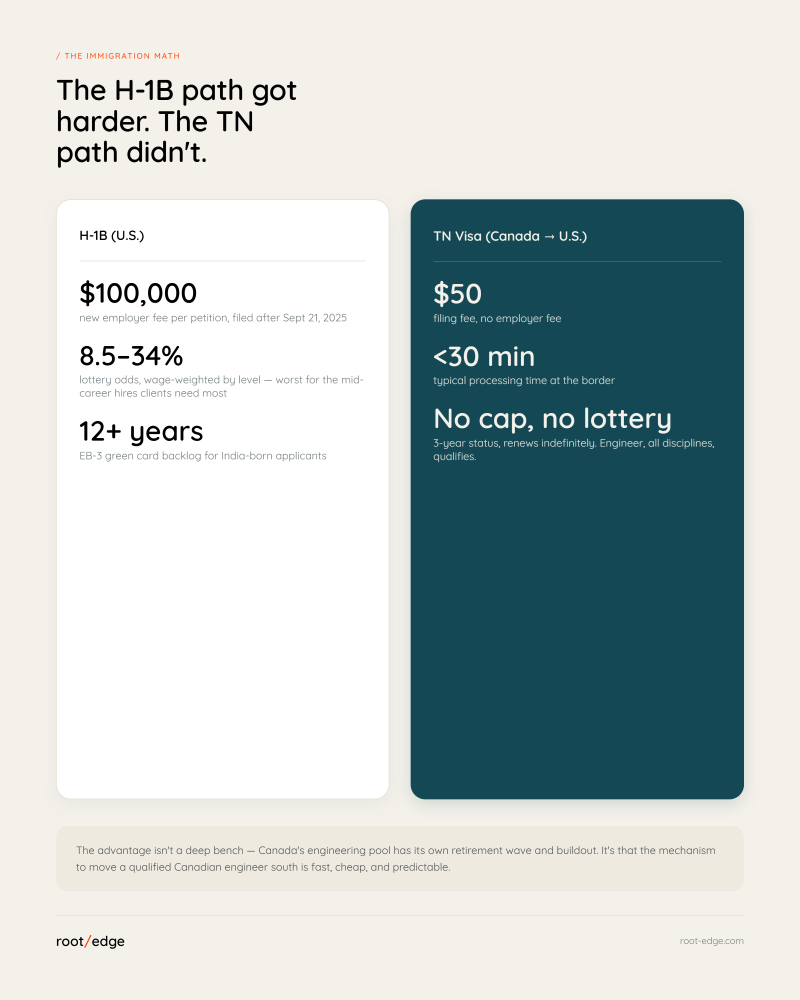
That said, don't mistake Canada for a deep bench of untapped supply. The Canadian engineering pool wasn't that large to begin with, and Canada is dealing with its own version of the same retirement wave, on top of its own buildout, including Ontario's nuclear expansion. Recruiting there means competing for candidates who already have good options at home, not fishing in an empty pond. The real advantage isn't volume. It's that the mechanism for moving a qualified Canadian engineer south is fast, cheap, and predictable, in a market where almost nothing else is. But if a client is counting on Canada to close a shortage measured in the hundreds of thousands, the numbers simply don't add up. It's one lever, not the fix.
Stop Hunting the Purple Squirrel
The bigger lever is the one most clients still haven't pulled, and it has nothing to do with immigration. It's the employer value proposition and whether you're actually willing to be flexible on it. Too many searches get stuck for six or twelve-plus months because the client is chasing a purple squirrel: someone who can sit down at the desk on day one and already do everything the role asks, with zero ramp time and zero risk. That candidate exists somewhere, rarely, and by the time you find them they have three other offers and no reason to take yours.

The clients who actually fill these roles on a reasonable timeline are the ones who go back and revisit the must-have list before they go back to market. They ask what's realistic given who's actually out there, not who they wish was out there. A good engineer who's missing one or two specific skills can usually learn them in six months on the job. Someone with two or three years less experience than the job posting asks for can grow into the role faster than clients expect, especially the younger, tech-savvy engineers who pick up new tools and systems quickly and end up catching up to their more senior peers sooner than anyone budgeted for. Location flexibility works the same way. A client anchored to one metro is competing for a fraction of the talent a client open to remote, hybrid, or relocation is competing for.
None of this replaces fixing the pipeline or fixing immigration. But while those take years to move, being honest about the must-have list and being flexible on where someone sits is the one lever a client can pull today.
So here's where I think this goes over the next 36 months. The gap between engineering headcount and grid capital spending widens before it narrows, because the fixes on the supply side, workforce development and immigration reform, take years longer than the capex timelines utilities are already committed to. Clients who lock in senior T&D and power systems talent now, build genuine relocation and TN pathways for Canadian candidates instead of treating it as a backup plan, and get realistic about who they're actually willing to hire and develop, will be executing while their competitors are still writing job descriptions for a candidate who doesn't exist. The ones who wait will end up bidding well over market for engineers who already have three offers on the table.
Sources:
- A Shrinking Workforce Threatens the Future of the Grid (IEEE Spectrum)
- Bridging the Gap: How the Power Industry Is Tackling Its Workforce Crisis (POWER Magazine, citing Goldman Sachs Research, IEA, U.S. DOE)
- The Retirement Ratio Threatening America's Power Grid (citing IEA World Energy Employment 2025)
- Energy Workforce Fast Facts (CEWD)
- NERC forecasts peak demand to rise 24% on new data center loads (Utility Dive)
- Surging energy demand puts US utility capex forecast near $1.3T in 2026-30 (S&P Global)
- USCIS Implements the H-1B Proclamation $100,000 Fee (American Immigration Council)
- USCIS Creates Weighted Selection Process for H-1B Cap Lottery (Mintz)
- EB-3 Green Card Statistics in 2026: Caps and Backlogs (Manifest Law)
- New F-1 Rule Could Delay OPT Hiring and Interrupt Employment (Morgan Lewis)
- TN Visa Guide for Canadians in 2026 (Berardi Immigration Law)
- Engineering Talent Shortages in Canada: Hiring Trends and Workforce Outlook (Agilus)